Why Traditional Perimeter Security Is No Longer Enough

The Perimeter Is Gone
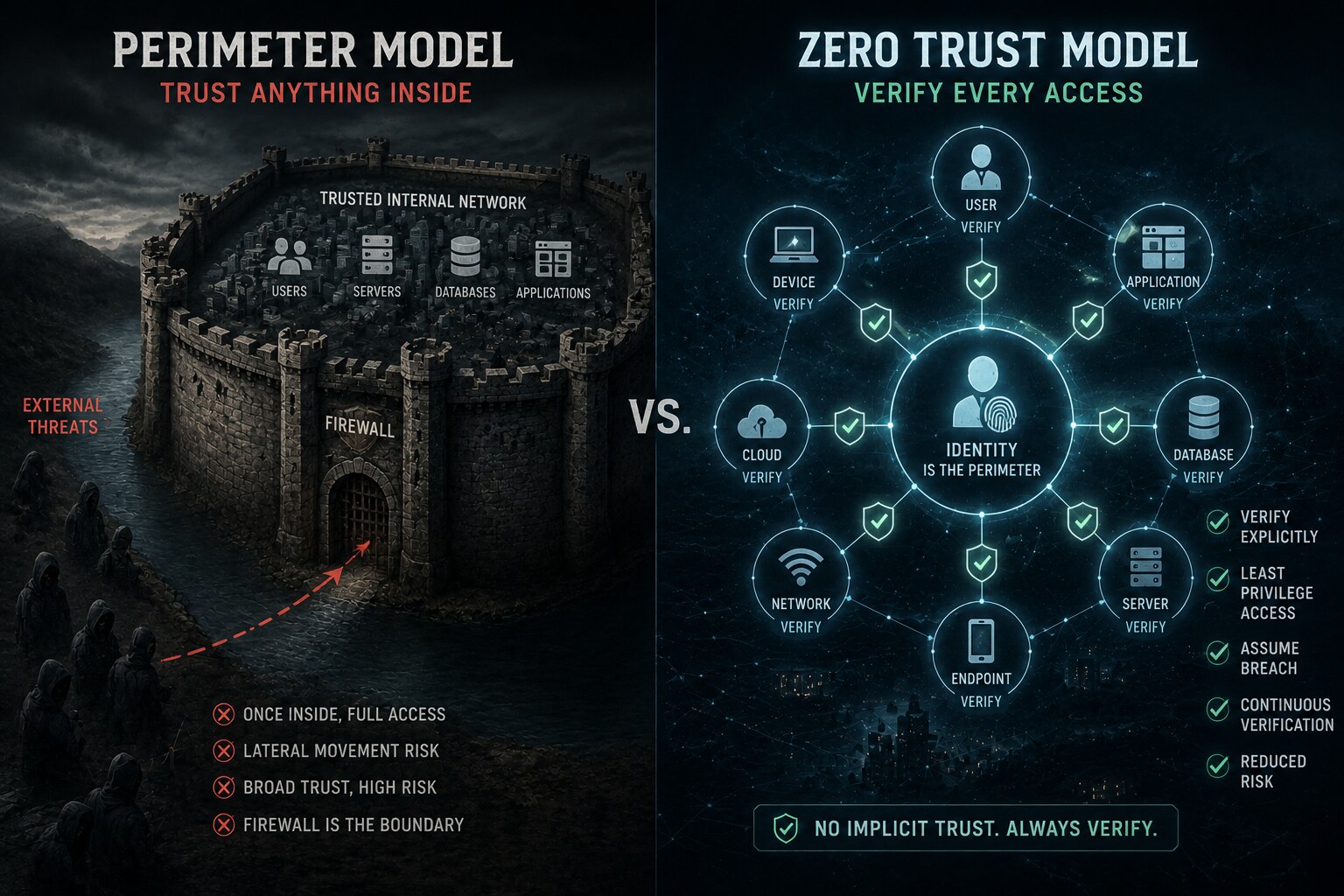
The traditional castle-and-moat security model assumed a clear boundary: everything inside the network is trusted, everything outside is untrusted. Cloud adoption, remote work, and BYOD policies have made this model obsolete.
In 2024, the average enterprise employee accesses 26 SaaS applications from 3.4 different devices, often from networks your IT team has zero visibility into.
What's Replacing the Perimeter
Zero Trust Architecture (ZTA) is the successor to perimeter security. Its core principle: never trust, always verify — regardless of whether a request comes from inside or outside the corporate network.
Key Controls in a Zero Trust Model
- Identity-centric access — who you are matters more than where you are.
- Micro-segmentation — limit blast radius if a breach occurs.
- Continuous verification — access decisions are made per-request, not per-session.
- Least-privilege — users get exactly the access they need, nothing more.
The Human Layer
Zero Trust secures the technical perimeter, but attackers increasingly bypass it entirely by targeting employees directly via phishing, vishing, and social engineering. A Zero Trust technical stack without a trained workforce leaves a critical gap.
Organisations that pair Zero Trust architecture with continuous security awareness training report 60% fewer successful social engineering attacks compared to those that implement technical controls alone.
Getting Started
You don't need to rearchitect everything at once. Start with identity: enforce MFA on every account, and you've completed the highest-impact step in any Zero Trust journey.
Download our Zero Trust Architecture guide for the full implementation roadmap.